Pasteur Network Vaccine Manufacturing Initiative: An important step toward decentralizing vaccine production with the participation of the Pasteur Institute of Iran
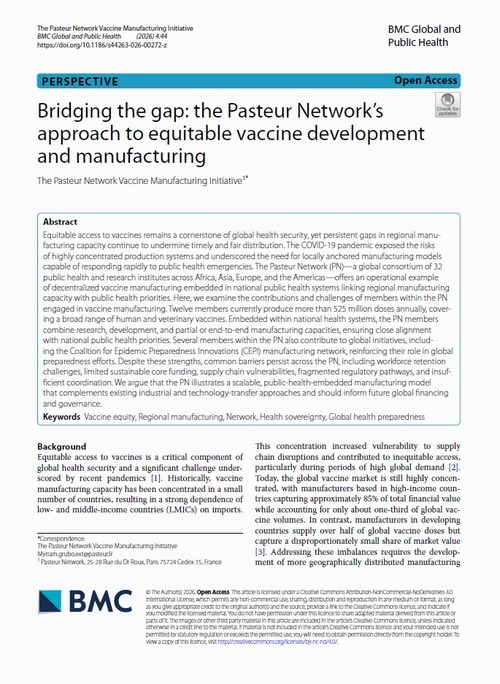
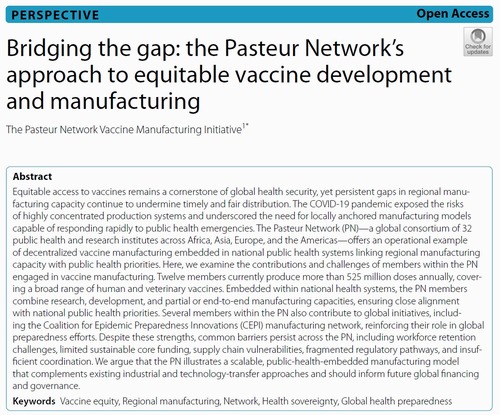
According to a scientific article published in the journal BMC Global and Public Health, the Pasteur Network has taken an important step toward decentralizing vaccine production and ensuring equitable access by launching its Vaccine Manufacturing Initiative (PN-VMI). The article, published in the May 2026 issue of the journal, reports that 12 members of the network currently produce more than 525 million doses of human and veterinary vaccines annually. The Pasteur Network comprises 32 research and public health institutes in 25 countries across five continents, encompassing more than 25,000 researchers, physicians, and technical staff.
The Pasteur Network Vaccine Manufacturing Initiative (PN-VMI) was launched in 2024 as a voluntary collaboration among members with vaccine development or production capabilities. Currently, 13 institutes participate in this initiative, the most notable of which include:
- Africa: Pasteur Institute of Algeria, Pasteur Institute of Dakar (Senegal), Pasteur Institute of Morocco, Pasteur Institute of Tunisia
- Asia: Pasteur Institute of Iran, Pasteur Institute of Vietnam (Nha Trang), Institute of Vaccines and Medical Biologicals (IVAC), National Institute of Hygiene and Epidemiology (NIHE) and Vabiotech (Vietnam), Pasteur Institute of South Korea
- Europe: Hellenic Pasteur Institute (Greece), Pasteur Institute of Paris and Lille (France)
- The Americas: Fiocruz / Bio-Manguinhos (Brazil)
Despite these capabilities, the article highlights common challenges such as lack of sustainable funding, supply chain vulnerabilities, weak regulatory systems, and brain drain. The authors emphasize that the Pasteur Network model—which integrates research, development, production, and public health surveillance within national health systems—could serve as a model for other regions of the world, provided it receives adequate financial support and policy attention.
The article mentions the Pasteur Institute of Iran as one of the members with vaccine production capacity. According to the author and member list, Dr. Alireza Kavianpour (Production and Planning Manager, Research and Production Complex) and Dr. Kayhan Azadmanesh (Head of Virology Research Group and Strategic Advisor to the Director General) are among the network members who contributed to the article. This paper is an outcome of the 2024 annual meeting of the Pasteur Network in Rio de Janeiro and the subsequent workshop in Casablanca (May 2025).
Source:
The Pasteur Network Vaccine Manufacturing Initiative;BMC Global and Public Health (2026) 4:44;https://doi.org/10.1186/s44263-026-00272-z
https://link.springer.com/article/10.1186/s44263-026-00272-z